

Overview
Start with the obstacle that is costing the most momentum.
Give routine questions, follow-ups, and internal handoffs a reliable first responder—designed around your real workflows, with clear boundaries and a human nearby when judgment matters.
What this helps solve
AI Agents & Chatbots
AI works best when it has a job description. Phase 3 helps Santa Barbara teams turn repeated conversations and process bottlenecks into useful agents and chatbots—without tossing a generic bot onto your website. Founded by Justin Soenke, we map the questions, systems, guardrails, and handoffs that matter, then build a practical experience your team can manage. The goal is simple: make everyday work easier while keeping customers and colleagues connected to people when it counts.
How it works
Useful progress looks different for every business.
What a good outcome can look like
- Fewer repeat questions landing in the same inbox
- Clearer next steps for leads, customers, and staff
- Human handoffs that arrive with useful context
Typical building blocks
- Conversation design and knowledge-base structure
- Website chat, internal assistants, or both
- Integrations with the tools your team already uses
- Permissions, escalation rules, and ongoing tuning
A sensible sequence
Our process
Each step creates the clarity needed for the one after it—without adding work that does not serve the goal.
- 01Clarify the business question
- 02Prioritize the useful work
- 03Build, improve, or connect the right pieces
- 04Measure the signal and refine the next move
General pricing
Use a range to plan. Use a quote to decide.
- Typical market range
- $8,000–$35,000 + $1,000–$5,000/month
- Common engagement
- implementation and support
These are broad U.S. small-business market reference ranges, not a Phase 3 quote, offer, or financing term. Scope, existing systems, content readiness, integrations, timelines, third-party platforms, advertising spend, taxes, and ongoing support can materially change the final investment.
Built for clear answers
Questions people ask before they get started.
Is this service right for my business?
Will this work with our existing systems?
How will we know if it is working?
Planning tools
Test the next move before you commit to it.
Use a website-profit scenario, work backward from a revenue goal, or compare the contribution of your inbound channels. Each tool starts with the assumptions you choose and gives you a clearer question to bring to the next conversation.
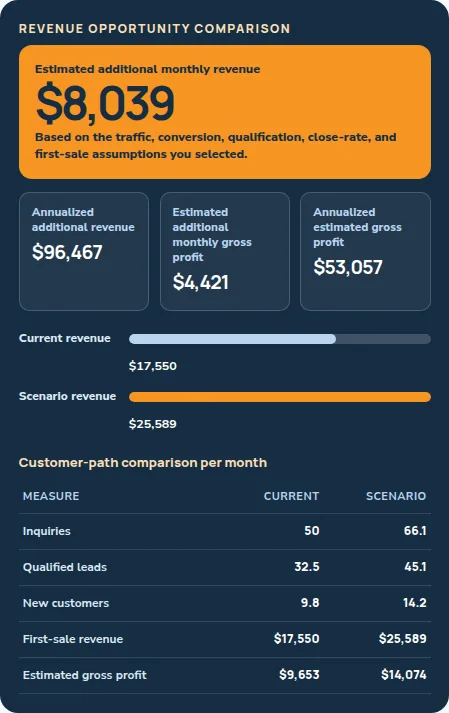
Website & marketing scenario
Website Profit Potential Calculator
Test how changes in traffic, inquiry quality, conversion, close rate, and first-sale value could affect first-sale revenue and estimated gross profit.
- A baseline from your website visitors, inquiries, qualification, closes, first sale, and margin
- The planning levers connected to traffic, conversion, qualification, close rate, and average first sale

Revenue-goal scenario
Reverse Revenue Planner
Start with traffic, recurring and new monthly buyers, current revenue, and a revenue goal to map the customer-path changes that could be worth testing.
- Your current traffic, recurring buyers, new buyers, and total monthly revenue
- A desired monthly revenue target and the modeled customer-path changes behind it
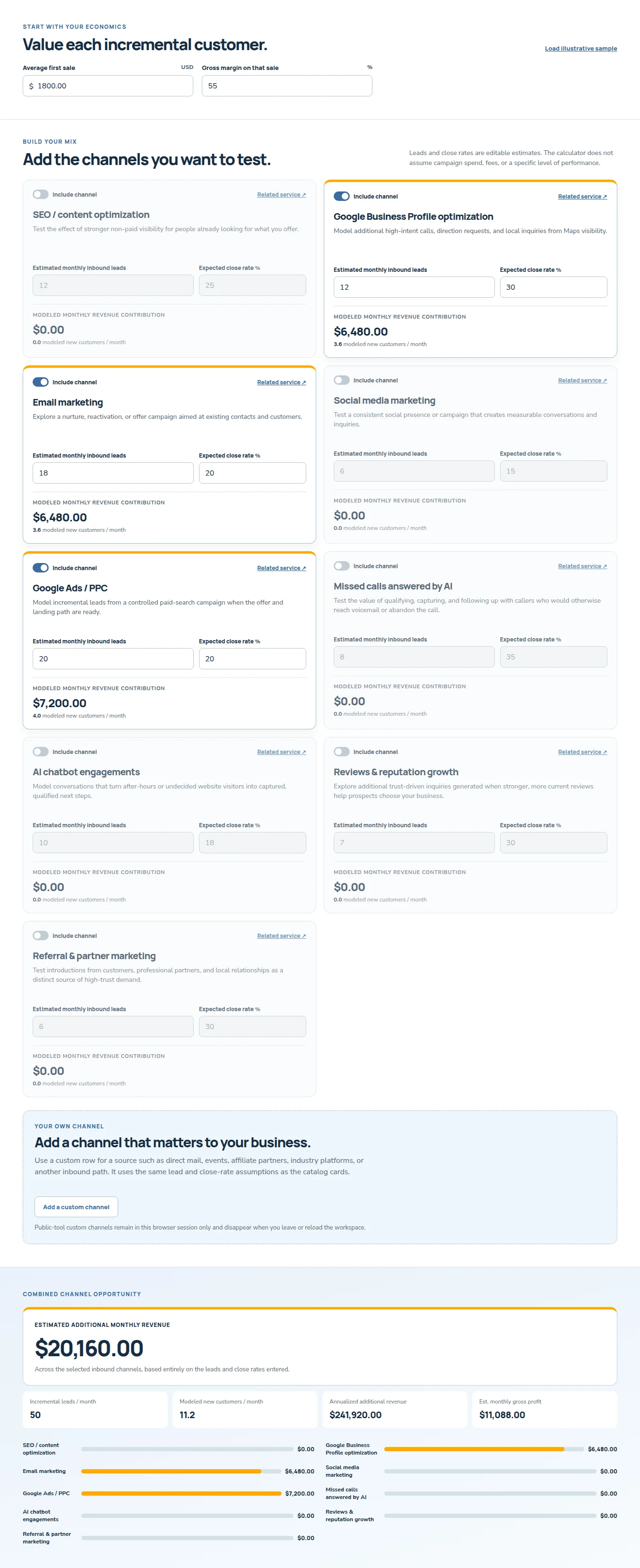
Marketing-mix scenario
Inbound Channel Impact Calculator
Compare a mix of search, local visibility, email, social, paid, AI-assisted, review, and referral channels using your own lead and close-rate assumptions.
- Ten inbound channels, including exit intent pop-ups & opt-ins, missed calls & DM's answered by AI, and AI chatbot engagements
- Expected inbound leads, close rate, average first sale, and gross margin for each selected channel
Planning notice. All calculator outputs are hypothetical projections; actual results will vary. Public workspaces start fresh and do not save scenarios, email reports, create prescriptions, or expose saved records.
Practical resources
Bring a more useful question to the next conversation.
Start with the checklist, then use the related learning below when it matches the decision in front of you.
Practical checklist
AI Agent Readiness Checklist
Set useful boundaries before putting an AI assistant in front of customers or staff.
- Define the single job, knowledge source, escalation path, and prohibited actions.
- Confirm human review points for sensitive, financial, or customer-impacting decisions.
- Prepare accurate source content, test questions, and an owner for ongoing monitoring.
Course
AI for Small Business: Start with the Workflow
A beginner-friendly path for finding useful AI opportunities and adding safe human review.
Get accessGuide
Common ChatGPT Mistakes
A useful checklist for avoiding unreliable output, vague prompts, and missed review steps.
Get accessThe branded checklist uses a short business-information form before download. Related courses and guides use their own opt-in forms; the self-check quiz is available directly.
